The Off-Peak Advantage: How Dynamic Electricity Pricing Is Quietly Rewiring the Tech Industry's Operating Clock
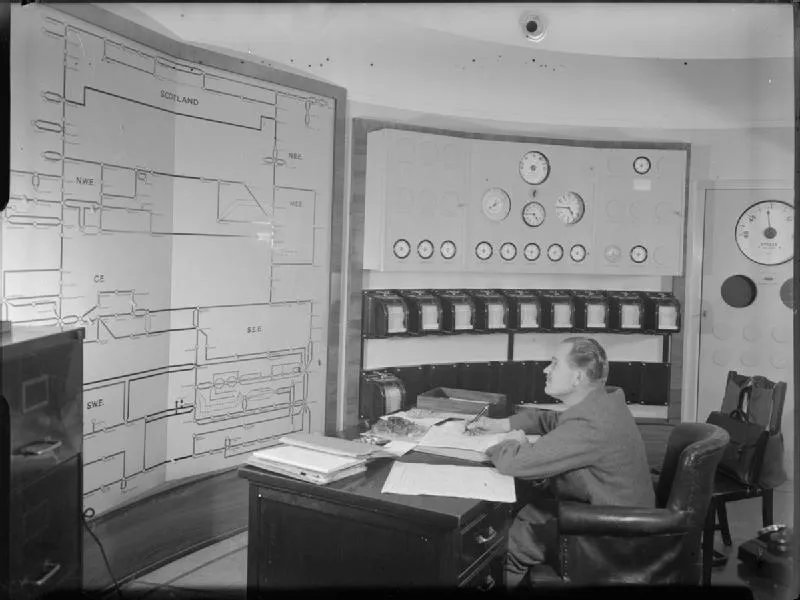
Photo: Ministry of Information Photo Division Photographer, Public domain, via Wikimedia Commons
There is a version of the American power grid that most consumers never see—one that prices electricity not as a flat commodity but as a dynamic resource whose value fluctuates by the minute, the hour, and the season. This is the grid that industrial-scale technology operators navigate daily, and their navigation of it is beginning to reshape services, schedules, and costs in ways that ripple outward to ordinary users.
Real-time electricity pricing, long the domain of industrial manufacturers and wholesale energy traders, has quietly become one of the most consequential variables in enterprise technology infrastructure planning. Understanding how it works—and why it matters beyond the utility sector—is increasingly essential for anyone who cares about the intersection of digital services and energy systems.
How Dynamic Pricing Works
Traditional retail electricity rates in the United States are largely flat or structured around simple time-of-use tiers: a slightly higher rate during daytime hours, a lower rate at night. But at the wholesale level—where grid operators such as PJM Interconnection, MISO, CAISO, and ERCOT manage the actual flow of electricity across regional transmission networks—prices are set in real time through competitive auctions that clear every five minutes.
These real-time locational marginal prices (LMPs) can swing from a few dollars per megawatt-hour during overnight valley periods to several hundred dollars per megawatt-hour during afternoon demand peaks on hot summer days. During extreme grid stress events—such as the 2021 Texas winter storm—wholesale prices briefly reached the state-mandated cap of $9,000 per megawatt-hour.
For large industrial consumers who have negotiated direct access to wholesale markets or who operate under interruptible service agreements, these price signals are not abstract data points. They are operational triggers.
The Tech Industry's Response: Load Shifting at Scale
Major cloud providers and hyperscale data center operators have been incorporating real-time pricing signals into their workload scheduling architectures for the better part of a decade. The practice is known as temporal load shifting—deliberately deferring computationally intensive but time-flexible tasks to periods when electricity is cheap and grid carbon intensity is low.
Google has been among the most publicly transparent about this approach. The company's Carbon-Intelligent Computing initiative, first detailed in 2020, routes batch processing workloads—tasks such as video transcoding, machine learning model training, and large-scale data analytics—toward time windows when renewable generation is abundant and grid prices are depressed. The system operates across Google's global data center fleet and reportedly shifts a meaningful percentage of total compute hours without degrading the latency-sensitive services that users interact with directly.
Microsoft has pursued a parallel strategy through its sustainability commitments, incorporating grid carbon intensity APIs into its Azure scheduling infrastructure. Amazon Web Services similarly offers customers tools to understand the carbon footprint of their cloud workloads by region and time of day—a feature that implicitly enables cost-aware scheduling as well as carbon-aware scheduling, since the two often correlate.
Cryptocurrency mining operations represent perhaps the most aggressive practitioners of real-time pricing arbitrage. Because proof-of-work mining is entirely time-flexible—the blockchain does not care whether a block is mined at 2 p.m. or 2 a.m.—miners can structure their operations to run at full capacity only when electricity prices fall below a profitable threshold, curtailing automatically when prices rise. Several large mining operations in Texas have formalized this relationship through demand response agreements with ERCOT, receiving payments for curtailing load during grid emergencies in exchange for preferential access to low-cost power during off-peak periods.
What This Means for Consumer Services
The operational implications of enterprise load shifting are not confined to data center economics. They produce observable, if subtle, effects on the consumer-facing services that run on this infrastructure.
Cloud service reliability metrics—measured by providers as availability percentages and tracked by independent monitors—can reflect the downstream effects of aggressive workload scheduling. When background processing tasks are concentrated in overnight windows, daytime compute resources are more available for interactive user requests, potentially improving response latency during peak consumer hours. Conversely, if scheduling algorithms are not precisely calibrated, batch workload surges can occasionally compete with real-time service demands even during nominally off-peak periods.
Internet performance data published by organizations such as Cloudflare and Fastly shows consistent diurnal patterns in request processing times across major platforms—patterns that align, at least partially, with the load-shifting schedules that infrastructure operators have publicly described. Attributing causality with precision is difficult, but the correlation is structurally plausible.
For consumers who use cloud-dependent applications—streaming services, collaborative software platforms, AI-assisted tools—understanding that the infrastructure beneath those services is dynamically scheduled against real-time energy pricing provides important context for interpreting performance variability.
The Consumer Opportunity: Leveraging Price Signals Directly
Real-time pricing is no longer exclusively an enterprise concern. A growing number of US utilities now offer residential time-of-use (TOU) rate structures, and some—including utilities operating under ERCOT in Texas and several California IOUs—offer dynamic pricing products that expose customers to wholesale-adjacent price signals.
For households with flexible loads—electric vehicle chargers, water heaters, smart appliances, home battery systems—these rate structures present a genuine financial opportunity. The same logic that drives hyperscale data center operators to shift workloads to off-peak windows applies, in scaled-down form, to residential energy management.
Several practical strategies merit consideration:
Schedule large digital workloads during off-peak windows. Home users who operate network-attached storage devices, run local AI model inference on high-powered workstations, or manage cryptocurrency mining rigs can apply the same temporal arbitrage logic as enterprise operators. Running these loads between 10 p.m. and 6 a.m. on a TOU rate can reduce per-kWh costs by 30 to 50 percent at many US utilities.
Use grid carbon intensity tools as a proxy for price. Apps and APIs such as WattTime and Electricity Maps provide real-time grid carbon intensity data by region. Because carbon intensity and wholesale price tend to correlate—both are lowest when renewable generation is abundant—these tools serve as accessible proxies for consumers without direct wholesale market access.
Evaluate dynamic rate enrollment carefully. Not all flexible loads are equally interruptible. Understanding which home systems can tolerate scheduling flexibility—and which cannot—is a prerequisite for dynamic rate participation that delivers savings without service disruption.
A Structural Shift, Not a Billing Footnote
It would be a mistake to categorize real-time electricity pricing as a narrow utility policy matter. What is unfolding is a structural realignment of the relationship between digital infrastructure and the power grid—one in which the clock of computing is increasingly synchronized with the rhythms of electricity supply and demand.
For the technology industry, this alignment is becoming a competitive differentiator. Operators who execute load shifting effectively reduce their energy costs, lower their carbon exposure, and in some markets generate direct revenue through grid services agreements. Those who ignore price signals leave measurable value on the table.
For consumers, the same dynamic represents an underutilized lever. The data to act on it is increasingly available. The rate structures to benefit from it are expanding. What remains is the decision to engage with the grid not as a passive utility but as an active, measurable system—one where timing, as much as technology, determines the cost of staying connected.