Charging on Their Own Terms: How EV Drivers Are Quietly Stressing the Evening Grid
The promise of electrified transportation has always carried a secondary clause, one that utilities, grid operators, and policymakers have been slow to price into public discourse. Every electric vehicle added to American roads represents not only a reduction in tailpipe emissions but also a new, high-draw load point — one that, under current behavioral patterns, tends to activate precisely when the grid is already under strain. The question Ampergram examines here is a measurable one: how are rapid EV charging networks reshaping regional load curves, and are the pricing tools currently deployed sufficient to redirect that demand to safer windows?
The Evening Convergence Problem
Grid operators across the United States have long managed what is known as the evening demand ramp — the period between approximately 5:00 p.m. and 9:00 p.m. local time when residential electricity consumption climbs sharply as households return home, activate HVAC systems, prepare meals, and power up entertainment devices. This ramp has been a known planning variable for decades.
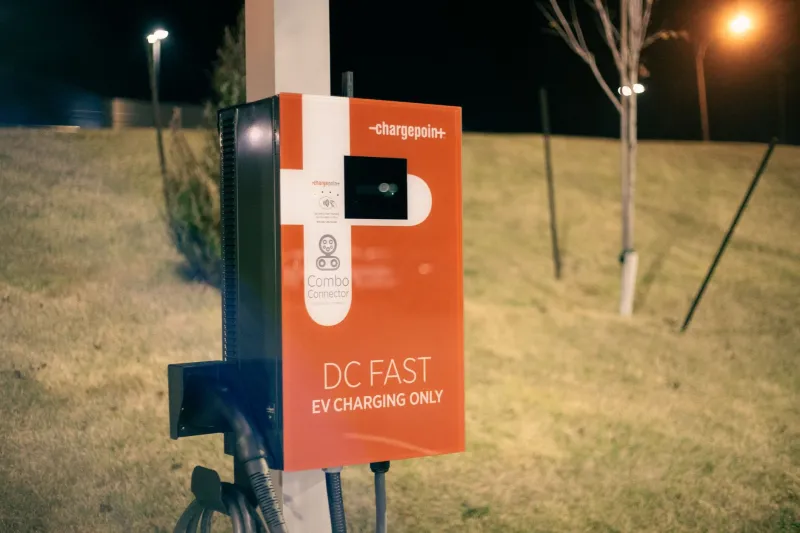
What is newer, and considerably less well-modeled, is the simultaneous activation of Level 2 and DC fast chargers during this same window. Data compiled from network utilization reports published by ChargePoint, EVgo, and Electrify America between 2022 and 2024 consistently shows peak session initiation clustering between 6:00 p.m. and 8:30 p.m. in major metropolitan markets including Los Angeles, the Dallas–Fort Worth Metroplex, and the greater Atlanta region. A single DC fast charger operating at 150 kilowatts draws roughly the equivalent of 30 to 50 average American homes running simultaneously. A charging plaza with eight such units represents a localized demand event that many distribution feeders were not engineered to accommodate at scale.
This is not a theoretical concern. Utility interconnection queues in California, Texas, and the mid-Atlantic states have documented increasing requests from charging network operators for dedicated transformer capacity, a signal that existing infrastructure is reaching practical limits in high-density corridors.
Regional Load Signatures: Not All Networks Are Equal
A meaningful distinction exists between charging networks when load patterns are examined at the regional level. Workplace and retail-adjacent charging stations — typically Level 2 installations operating between 6 and 19 kilowatts — tend to generate midday load that is broadly beneficial. It falls during solar generation peaks and, in many markets, aligns with periods of excess renewable output. Grid operators in California's balancing authority area have noted that midday charging actually helps absorb surplus solar production that would otherwise require curtailment.
DC fast charging corridors, by contrast, tell a different story. Highway-adjacent networks such as Tesla's Supercharger infrastructure and Electrify America's interstate stations generate more distributed temporal patterns because long-distance travel occurs at variable times. However, urban and suburban fast-charging clusters — increasingly common in parking structures and retail centers — mirror the residential demand curve with uncomfortable precision. Drivers returning from work stop to charge on the way home, or plug in immediately upon arrival, stacking their vehicle's demand directly onto the household and neighborhood load that grid operators are already managing.
When these load signatures are visualized by region, the contrast is instructive. The Pacific Coast, with its higher EV penetration and more aggressive renewable portfolio, shows a pronounced duck curve effect that is deepened, not alleviated, by evening charging behavior. The Southeast, where EV adoption is accelerating rapidly but grid modernization investment has lagged, presents a more acute reliability concern: distribution infrastructure that was built for a different demand profile is absorbing new, high-intensity load points without corresponding upgrades.
The Pricing Incentive Gap
Time-of-use pricing has been the primary policy instrument proposed to shift EV charging away from peak windows. The logic is sound in theory: charge drivers more during high-demand periods and less during overnight or midday hours, and rational actors will adapt their behavior accordingly. In practice, the evidence for widespread behavioral response is considerably more modest.
Several factors complicate the transmission of price signals to actual charging decisions. First, many public charging sessions are priced per-session or per-kilowatt-hour at rates that do not vary by time of day, effectively insulating drivers from the real-time cost of their demand. EVgo and ChargePoint have introduced time-differentiated pricing on portions of their networks, but adoption of subscription plans that flatten these signals remains high among frequent users. Second, the behavioral economics of EV charging differ meaningfully from other discretionary electricity uses. Drivers charge when the vehicle is present and when anxiety about range motivates action — not necessarily when grid conditions are optimal.
Third, and perhaps most structurally significant, residential charging — which accounts for the majority of EV energy consumption by volume — is often priced under flat-rate utility tariffs that provide no incentive for temporal shifting. Utilities in states including Georgia, Florida, and much of the Southeast have been slow to expand residential time-of-use rate availability, meaning that the price signal capable of reshaping overnight charging behavior simply does not exist for a substantial portion of the EV-owning population.
Measuring the Hotspot Effect
For grid operators, the challenge is not only aggregate demand but geographic concentration. A high-capacity charging plaza introduced to a distribution feeder that was designed for residential load creates what engineers refer to as a localized hotspot — a point of disproportionate stress that can affect power quality, transformer lifespan, and in extreme cases, service reliability for surrounding customers.
Advanced metering infrastructure and distribution management systems now allow utilities to monitor these conditions with considerably greater resolution than was available a decade ago. Some regional operators, including those within the PJM Interconnection and the Western Interconnection, have begun integrating charging network operational data into their real-time situational awareness tools. The goal is to identify emerging hotspots before they produce equipment failures rather than after.
But monitoring is not the same as mitigation. The tools for active demand management at the charging network level — including smart charging protocols that allow utilities or aggregators to modulate session power levels during grid stress events — remain unevenly deployed. Vehicle-to-grid capabilities, which would allow EVs to return stored energy to the distribution system during peak periods, are technically available in a growing number of vehicle models but face regulatory, tariff, and hardware barriers that have slowed meaningful adoption.
A Measurement Problem With Grid-Scale Consequences
What the data ultimately reveals is a system expanding faster than the measurement and management frameworks designed to govern it. EV adoption in the United States is following an accelerating curve, with the Department of Energy projecting tens of millions of electric vehicles on American roads by the early 2030s. The load implications of that trajectory, under current behavioral and pricing conditions, are not speculative — they are calculable, and they are significant.
The grid does not care about stated intentions or policy aspirations. It responds to actual amperage drawn at actual times from actual locations. Until pricing structures, smart charging infrastructure, and utility interconnection processes catch up to the pace of EV deployment, the evening demand window will continue to absorb a phantom fleet of vehicles charging on their own terms — and the stress that creates will remain a measurable, if still largely unaddressed, feature of America's energy transition.